Research Vision
Billions of dollars have been lost and human lives put at risk due to a simple, but vexxing, problem: misaligned expectations about what software is supposed to do. Nowhere is the impact felt more than in the programs and protocols underlying modern computer networks. Examples ranging from the Colonial Pipeline attack and Ethereum’s infamous DAO hack suggest that cybersecurity research has left a significant attack surface unprotected. On its face, the gap between protocol developers’ security expectations and the final designs or software they release into the world appears to be a “human problem” not solvable through technology. My work builds on the observation that protocol designers generally release an artifact—a specification, reference implementation, or even a prose description—and the insight that these artifacts can form the basis of a new solution to an age-old problem.
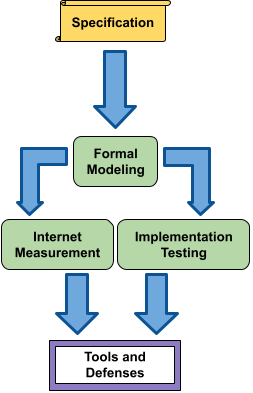
My research at the intersection of networks and distributed systems security uses a variety of empirical and formal methods to close the gap between theory and implementation of network protocols and shed light on exactly what makes them vulnerable, quantify exactly how vulnerable they are, and build safeguards to help people and organizations protect themselves. This approach has led me down three lines of inquiry: (1) blockchain security—the topic of my thesis; (2) hardening network policy frameworks; and (3) security analysis of anonymity systems.
My research uses techniques from both science and engineering. Following the scientific method, I establish hypotheses of secure protocol operation in the form of formal models derived from specifications, then I evaluate these hypotheses by performing Internet measurements and testing protocol implementations to understand if the expectations of the systems are satisfied—thereby confirming or rejecting the hypotheses. For example, in one project I built a formal model of a defense against transaction reordering in Ethereum, and used that model to inform blockchain measurements in which the goals of the protocol were violated. I also lean on my professional engineering background to use insights from measurements and testing to design and build analysis tools to deepen understanding of protocol attack surfaces and create defenses. I use a combination of methods to perform these analyses including model checking, static program analysis, differential analysis, simulation, and emulation. Because of the targeted nature of this approach, these analyses have all yielded insights that have resulted in the wholesale redesign of a popular blockchain protocol, two research awards, and two CVEs (officially authorized public disclosures).